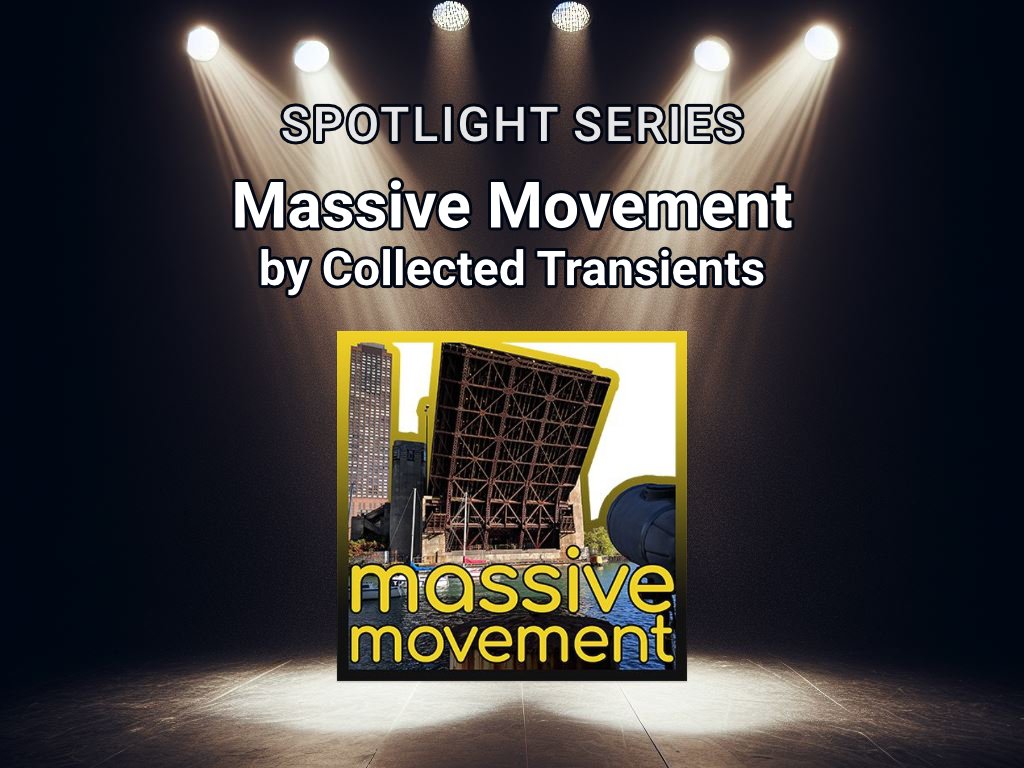
I was quite excited last week when I saw Collected Transients had added a new library to Sound Effects Search. I’ve been a fan of Stosh Tuszynski’s creations for years. Each of his libraries go beyond just simply recording expertly; there’s a lot of thought that goes into each of his projects. It shows in the result – the Collected Transients libraries are fan favorites in the sound design community.
I reached out to Stosh to see if he would like to share his experience creating the library. He very kindly agreed.
In today’s spotlight post we’ll learn how and why Tuszynski recorded the new Massive Movement library. He shares insights on urban recording, gear choice, the goal of creating quality over quantity, and explores the question – is a sound library ever “done”?
Let’s learn more.
Collected Transients’ sound libraries are always quite interesting and eclectic. You always find and record interesting subjects. Can you share with readers how you came up with the idea for Massive Movement?

Thanks, Paul! I suppose the initial idea came from me witnessing a bridge lift about 5 years ago. There was a large crowd around the Michigan avenue bridge watching it go up and it let out the wildest high pitched groan. I obviously thought that was very cool at the time, but fairly quickly threw away the idea of ever recording it as there were far too many people around to get anything worthwhile. As the years went on and my skills as an urban field recordist improved, the idea of getting quality recordings of bridge lifts became more and more obtainable. That, and me realizing that there just aren’t too many libraries with massive real-world source material out there, led me to think it might make a nice sound effects library.
Many of your sound libraries – such as Combustion, Thermal Flux, and others – are designed and specifically recorded as sound design tools. How does Massive Movement help with sound design?
If the name doesn’t already imply it, I think Massive Movement is especially helpful for any design moment where you need something to sound huge. If you’ve got a massive creaking ship or a building about to collapse I could see many of the bridge creaks and friction sounds working great for you. In a less literal sense, I could see many of the bridge groans and roars working as layers in creature vocal design if you got creative enough! The high speed train has a wild sounding doppler whoosh effect that would be great for stylized transitions among other things. I’m excited to see the creative ways it gets used!
Can you tell us what are some of your favorite sounds from the collection?
I think I’m most proud of the cleanest recordings I was able to capture. The first set being the Canal Street Rail Bridge recordings. I worked out a really nice place to record from that was very close to the bridge and out of the public eye. Also, not many people were ever there for that bridge as it was much less of a touristy area. I loved how consistent the bridge was at making unique sounds and it just had this constant rolling rumble sound that I feel like just really exemplifies what I was going after for this library.
The others would be the high speed train recordings. It was something where I did a ton of research prior to recording to find the sections of track where the trains hit the highest speed as well as areas where I could effectively and legally record them. I also went there at a time of year when there were almost no insects or birds in the area so the recordings just turned out super clean. You can crank up the super distant train approaching sound quite a lot and it still sounds great!
How did you choose the gear you needed to record for this library?
This library required me to be very mobile, specifically for the bridge recording sessions. Chicago has scheduled bridge lifts during two periods of the year. One in the spring, where the boats make the journey from their storage yards out to Lake Michigan for the (far too short) Chicago summer. And another in the fall, where the reverse happens. Each scheduled bridge lift day, boats queue up at the first bridge to wait for it to lift. The bridge raises, all the boats go through, and the bridge is promptly lowered again. In my experience, from the start of the bridge lifting up, to the moment it’s set down is usually 5 minutes or less. And as soon as the boats get to the next bridge, the process starts again. Sometimes the next bridge lifts before the previous bridge even goes down. When things are running smoothly, it’s an amazingly fast process! Which makes sense, as each lift totally cuts off vehicle and pedestrian traffic on a busy downtown street.

All that’s a long way of saying I really needed to be able to move efficiently! I had to be able to pick up my gear quickly and run to the next bridge in time for the lift. It was honestly a good (stressful) workout! So for the most part I went with a simple XY mic rig on a lightweight stand and a handheld shotgun mic. I had a small audio bag for my recorder, and a camera with a flexible tripod. It was good practice for my cable management. Nothing was more embarrassing than getting wrapped up in my own cables as I ran between bridges during my early record sessions.
For the library you’ve recorded Chicago’s huge bridges raising and lowering from the riverside and also the lift room and the funicular machine room in Pittsburgh. How did you get special access to these places?
Two pretty different situations actually! For the bridge lift room, I had worked on a separate non-library project that involved the bridges and developed a relationship with the operating staff. After showing some interest in recording one of the lifts, they set me up! Quite an odd experience seeing the lift happen from “inside” the bridge.
For the funicular, it was really a right place, right time, and right attitude kind of situation. I was on a trip to record a hail cannon for another library and decided to stop in Pittsburgh for no other reason than I’d never been there. While out to eat, I scrolled around on the map to find things to do and saw a funicular! Aside from the idea of recording it, I’m just a geek for that kind of thing. Weirdly specific machines that you don’t see too often. Things like Trench Rammers and doorless elevators just get me going. Tom Scott and I would get along great, I think.
I arrived at the funicular without having done much research and bought a ticket and rode to the top. It was a neat short ride with great views of the area, and it only cost a couple bucks. At the top, I saw you could take a self guided tour of the machine room so I walked right in. There were about six people wandering around and a worker doing some kind of maintenance. I got to talking with them about what they were doing and they explained that they were working on the backup motor… and that both motors had a backup generator incase power went down. I asked about how strong the motors were and how they still operate with wooden gears. I’d like to think my genuine interest in the machinery and what they were doing helped when I asked if I could record it. They happily accommodated me and shut the doors to the machine room for about 15 minutes so I could record a few things with no one else around. In my experience, nerds, whether they’re into maintaining funiculars or recording bridges, just sort of get each other. It’s a unique bond that I think can really help when you’re trying to gain access to recording special equipment or locations.
The bridges, trains, and other areas featured in the library are in the middle of the city. How were you able to record cleanly, without interference by people, traffic, boats, and so on?
Recording in a city is something I’ve learned to make the most of over the years. It’s a source for all kinds of unique sounds, but also the source of a million extraneous sounds to ruin your recordings. Through plenty of trial and error, I’ve learned to mitigate the interference through a variety of techniques. I even wrote a lengthy blog post about it! To summarize, for me it comes down to figuring out the times, locations, and weather conditions which most inhibit others from even being there in the first place to ruin your recordings. On days when the weather is ice cold and misty, many fewer people are going outside. The random seedy looking alley is less likely to have people walking by your mics than a busy street. Recording at 3am can really limit the amount of people you’ll even see while you’re out.
When it came to the bridges, however, I was pretty limited on the amount of control I had. They were scheduled on specific dates, started at specific times, and of course I had no choice on location. So for the most part I had to rely on less than stellar weather and brute force. Most of the bridges that ended up in the library were recorded during the seasonal fall lifts. It was more likely to be cold and overcast, so less people were out. There were also times it rained during the scheduled lifts, which really drove people inside. If it sucked for me to be out there, I knew that meant the majority of people wouldn’t be out, which isn’t fun at the moment, but is great for the end result! I also just recorded a TON of bridge lifts and was able to pick out the cleanest recordings for the library. I’d estimate that I only used about a quarter of the recordings in the end.
What’s next for Collected Transients?
Well, on the library front, I’ve got two very fun sound design focused libraries that are in the later stages of development. To be frank and go off subject for a second, something I’ve always struggled with is knowing when to call a library “done”. It’s been such a difficult thing for me to know when enough is enough. I even struggled with it for Massive Movement. I always had the voice in the back of my head saying, “If I just recorded one more set of bridge lifts…”, and so on. Aside from keeping my own second guessing in check, showing the work in progress of the library to a few audio friends and hearing what they thought really helped for this one. So all that is to say, both of these libraries have a ton of stuff I’m really excited for others to hear and design with. I just need to get to the point where I’m confident I’ve done enough to provide a library worthy of people spending their hard earned dollars on it.

In the slightly bigger picture, I’d love to do more ambience libraries! Right now I have my two “Diffuse City” collections, which I think nicely filled a void in what was out there for city ambience libraries. The idea of a non-distracting urban ambience library came from my own frustrations while editing backgrounds on films and commercials. I think editing/design struggles are great sources of inspiration for libraries, because if you’re wishing something out there existed and it would save you time, there’s a good chance others feel the same way. So I do have a couple ideas for ambience libraries that are inspired in that light.
The BIG picture? I just want to keep Collected Transients as fresh and inspired as it was when I started it. I’ve gone through a lot of personal and professional changes since it started back in 2015. The amount of time and energy I’ve been able to put into it has varied a lot over the years, but never at the cost of quality of content, just in quantity of libraries. I’d rather go a year or two without putting anything out than put out something I’m not happy with. I’ve found staying true to that mentality has led to good things for Collected Transients, so I plan on sticking to that and keeping faith that more good things will come!
Read More
- Check out the Massive Movement sound library.
- Watch a walkthrough on how to use the Massive Movement collection.
- Read an interview with Stosh Tuszynski on the Creative Field Recording blog.
Spotlight Series: Cosmos by Rescopic Sound
Follow Us